Motorbikes and scooters are the most popular means of transport in Thailand and in most of Southeast Asia. They're agile, take up little space, and are relatively cheap to buy and maintain. Especially in heavy traffic, it's a real advantage to get around on a motorbike. It gets you to your destination faster, while cars and trucks crawl along in traffic.
But please be careful!!!!
Riding a motorbike in Thailand can also be very dangerous! That's why, in this article, we want to help you make your scooter ride as safe as possible! Stick to our 10 Scooter Rules to reduce the risk of an accident on the roads of Koh Samui and Thailand!
Driving on the leftThe top 10 scooter rules
Thailand is one of the last 58 countries where they still drive on the left. Because of the daily routine of driving on the right back home in the West, left-hand traffic is often disregarded, leading to serious accidents. There are particular dangers when turning right and overtaking other vehicles. Two-wheelers, as well as cars, should always only be overtaken on the right! You should also be careful of vehicles coming towards you against the direction of travel. It's best to make eye contact with the other driver, to signal that you have the traffic situation under control.
Don't be a road blockThe top 10 scooter rules
The idea that "traffic has to keep flowing" isn't necessarily a MUST in Thailand. There's no stress or hurry here. Turning, parking or overtaking manoeuvres often happen in slow motion, and the traffic behind comes to a standstill. Sudden manoeuvres - like stopping to snap a spontaneous holiday photo, turning unpredictably without indicating or signalling by hand, or riding side by side in groups while chatting - often create obstacles in traffic. Trying to overtake these "traffic-brakes" is often dangerous and can lead to unexpected overtaking manoeuvres by the traffic behind you.
Leaning into cornersThe top 10 scooter rules
One of the many reasons accidents happen so often is leaning too far into corners. The roads here are often poorly built or have poor visibility. Suddenly, while leaning into a bend, you notice a big pothole, and your reflex is to swerve, which can then prove fatal. You should always be able to see the whole curve, take it from outside to outside (right-hand bend) or inside to inside (left-hand bend), and apply braking and acceleration sensibly.
Traffic rulesThe top 10 scooter rules
Here in Thailand, the rule is: keep your eyes open. You can't and shouldn't rely on the rules and traffic signs you've learned back home. Pavements, red traffic lights, driving the wrong way down a one-way street, right-of-way or left-of-way - whichever suits the moment better - people simply drive wherever there's space. You have to drive very defensively! Many traffic situations are unpredictable but manageable, as long as you always keep your own vehicle under control. Children as young as 7 ride to school without a helmet, 3-4 people to a bike, and unfortunately still have no theory or riding experience. You should watch the traffic and always expect unpredictable reactions from other road users.
Indicating too lateThe top 10 scooter rules
People very often forget to turn their indicator off, or leave it on, or it quickly gets missed behind sunglasses in the bright daylight. Many riders don't even know how to switch the indicator off - although it's really simple, just press it back to the middle position. A safe following distance is unheard of in Thailand, and you'll sometimes get overtaken tightly on both sides or cut off. Because of this, following traffic often finds it hard to spot a set indicator among all the others. It's also a good idea, though not strictly necessary, to give a hand signal before changing lanes or turning. One of the most common causes of accidents is changing lanes or turning correctly. It would be a shame if your holiday had to end early just because a reckless driver - and there are plenty of them here - runs into you and, in the worst case, even flees the scene. Because a Thai driver often doesn't have adequate insurance to cover damages - tourists even more often than not! - this is unfortunately not a one-off, and you're on your own if an accident does happen.
A few quick tips:
- Adjust your mirrors correctly before every ride.
- When turning: pay attention to the right-of-way situation, check the traffic behind you in the mirror, then indicate and do a shoulder check to make sure it's clear, position yourself correctly, adjust your speed, and properly assess the traffic to complete the turn safely.
Road surfaceThe top 10 scooter rules
Keep in mind that there are no street-sweeping vehicles or fire departments that put up warning signs or respond to spilled oil and the like. Here, everyone is responsible for themselves. On top of the generally slippery, sun-baked asphalt, you'll also find things like: rubbish, sand, obstacles such as lost items, stray dogs, coconuts, missing manhole covers, or sometimes massive potholes. Always ride in a way that keeps you constantly in control of your vehicle in every traffic situation!
Rain at nightThe top 10 scooter rules
During heavy downpours, sand and debris get washed down onto the road from the nearby mountains. At night, on flooded stretches of road, these are very hard to spot. Visibility is also often badly affected by the rain, even through a helmet visor. In places you also have to watch out for aquaplaning, as well as riding through small streams and flooded sections of road. On top of that, there are extra risks and dangers at night: oncoming traffic with high beams, lost objects, stray dogs, rocks, and more. We recommend: NEVER ride at night in the rain! If necessary, park your scooter, take a taxi, and pick it up again the next day or at a later time.
Wear a helmetThe top 10 scooter rules
Helmet on, engine on.
Unfortunately, most fatal accidents are the result of reckless, overly fast riding without a helmet. Most often it's simply laziness, or the excuse: "It's just a short ride... I don't need a helmet!". We recommend investing in a proper motorcycle helmet with a visor! Most rental helmets are often of very poor quality, not safety-certified, and simply unusable. By comparison, a good bicycle helmet actually protects you better than the standard plastic helmets you get in Thailand... There's officially a helmet requirement on Koh Samui, punishable by a 500 THB fine per person if you're caught without one. But if you're in an accident that affects your head, that fine should really be the least of your worries... WEAR A HELMET! ANYTHING ELSE IS DUMB, DUMBER, THE DUMBEST, AAAND EVEN MUCH, MUCH DUMBER SQUARED!!!
It's advisable... Wait..... It's MANDATORY!, to check the condition and mechanics of a scooter before renting it!!! You can follow all our previous points as carefully as you like, but if the rented scooter suddenly loses a wheel or the brakes give out while you're riding at full speed... Then the risk that you'll never be able to make your return trip, let alone another holiday, ever again, is very high!
Before setting off, you should:
- Ask what fuel it takes and check the fuel level,
- Check the tyres for pressure and tread depth,
- Take a look at the brake levers / brake fluid / brake discs and brake pads.
- Check the lights (dashboard, front, rear, indicators) and horn.
Also, be careful on long, steep stretches of road, as the brakes can overheat. It's advisable to ride down a steep section in stages, so the brake fluid has time to cool down again. Note: cooling the brakes with, say, water is completely pointless and simply ridiculous. To spare yourself trouble when returning your rental vehicle, it's important and helpful to take photos/videos to document any scratches or damage!The best tours on Koh Samui Explore now

 Thailand is one of the last 58 countries where they still drive on the left. Because of the daily routine of driving on the right back home in the West, left-hand traffic is often disregarded, leading to serious accidents. There are particular dangers when turning right and overtaking other vehicles. Two-wheelers, as well as cars, should always only be overtaken on the right! You should also be careful of vehicles coming towards you against the direction of travel. It's best to make eye contact with the other driver, to signal that you have the traffic situation under control.
 The idea that "traffic has to keep flowing" isn't necessarily a MUST in Thailand. There's no stress or hurry here. Turning, parking or overtaking manoeuvres often happen in slow motion, and the traffic behind comes to a standstill. Sudden manoeuvres - like stopping to snap a spontaneous holiday photo, turning unpredictably without indicating or signalling by hand, or riding side by side in groups while chatting - often create obstacles in traffic. Trying to overtake these "traffic-brakes" is often dangerous and can lead to unexpected overtaking manoeuvres by the traffic behind you.
 One of the many reasons accidents happen so often is leaning too far into corners. The roads here are often poorly built or have poor visibility. Suddenly, while leaning into a bend, you notice a big pothole, and your reflex is to swerve, which can then prove fatal. You should always be able to see the whole curve, take it from outside to outside (right-hand bend) or inside to inside (left-hand bend), and apply braking and acceleration sensibly.
 Here in Thailand, the rule is: keep your eyes open. You can't and shouldn't rely on the rules and traffic signs you've learned back home. Pavements, red traffic lights, driving the wrong way down a one-way street, right-of-way or left-of-way - whichever suits the moment better - people simply drive wherever there's space. You have to drive very defensively! Many traffic situations are unpredictable but manageable, as long as you always keep your own vehicle under control. Children as young as 7 ride to school without a helmet, 3-4 people to a bike, and unfortunately still have no theory or riding experience. You should watch the traffic and always expect unpredictable reactions from other road users.
 People very often forget to turn their indicator off, or leave it on, or it quickly gets missed behind sunglasses in the bright daylight. Many riders don't even know how to switch the indicator off - although it's really simple, just press it back to the middle position. A safe following distance is unheard of in Thailand, and you'll sometimes get overtaken tightly on both sides or cut off. Because of this, following traffic often finds it hard to spot a set indicator among all the others. It's also a good idea, though not strictly necessary, to give a hand signal before changing lanes or turning. One of the most common causes of accidents is changing lanes or turning correctly. It would be a shame if your holiday had to end early just because a reckless driver - and there are plenty of them here - runs into you and, in the worst case, even flees the scene. Because a Thai driver often doesn't have adequate insurance to cover damages - tourists even more often than not! - this is unfortunately not a one-off, and you're on your own if an accident does happen.
A few quick tips:
- Adjust your mirrors correctly before every ride.
- When turning: pay attention to the right-of-way situation, check the traffic behind you in the mirror, then indicate and do a shoulder check to make sure it's clear, position yourself correctly, adjust your speed, and properly assess the traffic to complete the turn safely.
People very often forget to turn their indicator off, or leave it on, or it quickly gets missed behind sunglasses in the bright daylight. Many riders don't even know how to switch the indicator off - although it's really simple, just press it back to the middle position. A safe following distance is unheard of in Thailand, and you'll sometimes get overtaken tightly on both sides or cut off. Because of this, following traffic often finds it hard to spot a set indicator among all the others. It's also a good idea, though not strictly necessary, to give a hand signal before changing lanes or turning. One of the most common causes of accidents is changing lanes or turning correctly. It would be a shame if your holiday had to end early just because a reckless driver - and there are plenty of them here - runs into you and, in the worst case, even flees the scene. Because a Thai driver often doesn't have adequate insurance to cover damages - tourists even more often than not! - this is unfortunately not a one-off, and you're on your own if an accident does happen.
A few quick tips:
- Adjust your mirrors correctly before every ride.
- When turning: pay attention to the right-of-way situation, check the traffic behind you in the mirror, then indicate and do a shoulder check to make sure it's clear, position yourself correctly, adjust your speed, and properly assess the traffic to complete the turn safely.
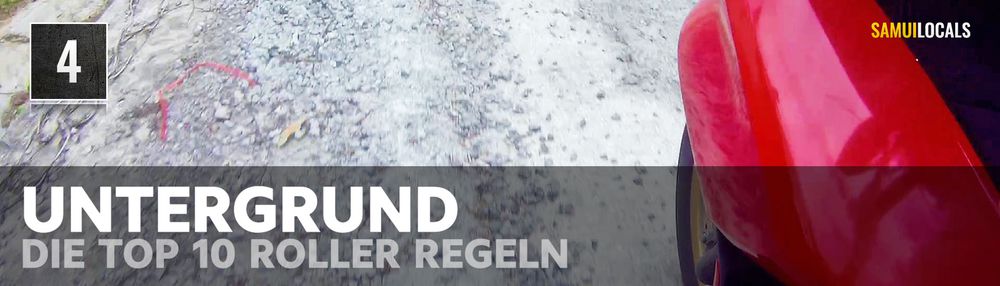 Keep in mind that there are no street-sweeping vehicles or fire departments that put up warning signs or respond to spilled oil and the like. Here, everyone is responsible for themselves. On top of the generally slippery, sun-baked asphalt, you'll also find things like: rubbish, sand, obstacles such as lost items, stray dogs, coconuts, missing manhole covers, or sometimes massive potholes. Always ride in a way that keeps you constantly in control of your vehicle in every traffic situation!
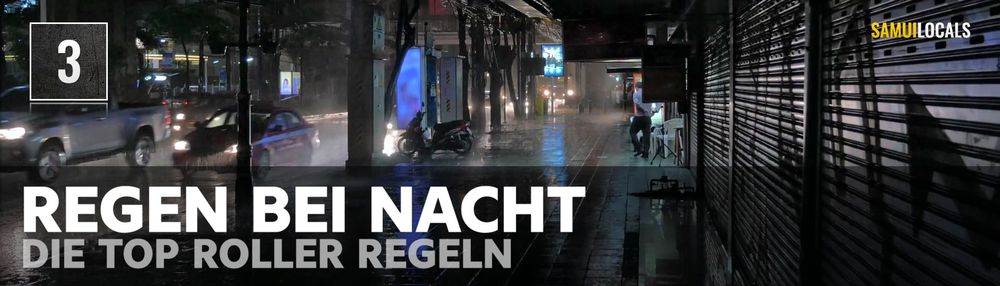 During heavy downpours, sand and debris get washed down onto the road from the nearby mountains. At night, on flooded stretches of road, these are very hard to spot. Visibility is also often badly affected by the rain, even through a helmet visor. In places you also have to watch out for aquaplaning, as well as riding through small streams and flooded sections of road. On top of that, there are extra risks and dangers at night: oncoming traffic with high beams, lost objects, stray dogs, rocks, and more. We recommend: NEVER ride at night in the rain! If necessary, park your scooter, take a taxi, and pick it up again the next day or at a later time.
 Helmet on, engine on.
Unfortunately, most fatal accidents are the result of reckless, overly fast riding without a helmet. Most often it's simply laziness, or the excuse: "It's just a short ride... I don't need a helmet!". We recommend investing in a proper motorcycle helmet with a visor! Most rental helmets are often of very poor quality, not safety-certified, and simply unusable. By comparison, a good bicycle helmet actually protects you better than the standard plastic helmets you get in Thailand... There's officially a helmet requirement on Koh Samui, punishable by a 500 THB fine per person if you're caught without one. But if you're in an accident that affects your head, that fine should really be the least of your worries... WEAR A HELMET! ANYTHING ELSE IS DUMB, DUMBER, THE DUMBEST, AAAND EVEN MUCH, MUCH DUMBER SQUARED!!!
It's advisable... Wait..... It's MANDATORY!, to check the condition and mechanics of a scooter before renting it!!! You can follow all our previous points as carefully as you like, but if the rented scooter suddenly loses a wheel or the brakes give out while you're riding at full speed... Then the risk that you'll never be able to make your return trip, let alone another holiday, ever again, is very high!
Before setting off, you should:
- Ask what fuel it takes and check the fuel level,
- Check the tyres for pressure and tread depth,
- Take a look at the brake levers / brake fluid / brake discs and brake pads.
- Check the lights (dashboard, front, rear, indicators) and horn.
Also, be careful on long, steep stretches of road, as the brakes can overheat. It's advisable to ride down a steep section in stages, so the brake fluid has time to cool down again. Note: cooling the brakes with, say, water is completely pointless and simply ridiculous. To spare yourself trouble when returning your rental vehicle, it's important and helpful to take photos/videos to document any scratches or damage!
Helmet on, engine on.
Unfortunately, most fatal accidents are the result of reckless, overly fast riding without a helmet. Most often it's simply laziness, or the excuse: "It's just a short ride... I don't need a helmet!". We recommend investing in a proper motorcycle helmet with a visor! Most rental helmets are often of very poor quality, not safety-certified, and simply unusable. By comparison, a good bicycle helmet actually protects you better than the standard plastic helmets you get in Thailand... There's officially a helmet requirement on Koh Samui, punishable by a 500 THB fine per person if you're caught without one. But if you're in an accident that affects your head, that fine should really be the least of your worries... WEAR A HELMET! ANYTHING ELSE IS DUMB, DUMBER, THE DUMBEST, AAAND EVEN MUCH, MUCH DUMBER SQUARED!!!
It's advisable... Wait..... It's MANDATORY!, to check the condition and mechanics of a scooter before renting it!!! You can follow all our previous points as carefully as you like, but if the rented scooter suddenly loses a wheel or the brakes give out while you're riding at full speed... Then the risk that you'll never be able to make your return trip, let alone another holiday, ever again, is very high!
Before setting off, you should:
- Ask what fuel it takes and check the fuel level,
- Check the tyres for pressure and tread depth,
- Take a look at the brake levers / brake fluid / brake discs and brake pads.
- Check the lights (dashboard, front, rear, indicators) and horn.
Also, be careful on long, steep stretches of road, as the brakes can overheat. It's advisable to ride down a steep section in stages, so the brake fluid has time to cool down again. Note: cooling the brakes with, say, water is completely pointless and simply ridiculous. To spare yourself trouble when returning your rental vehicle, it's important and helpful to take photos/videos to document any scratches or damage!


